

Dental implants enable patients to receive fixed dental prostheses in virtually any clinical situation, restoring full aesthetics and chewing function. A dental implant is shaped like a titanium screw that resembles a tooth root.
Dental implants were first used in the 1980s and have undergone rapid development ever since. Today, the success rate of dental implants ranks among the very highest in medical procedures, with a survival rate of up to 98.8% (Citation: “10-Year Survival and Success Rates of 511 Titanium Implants,” Buser D. et al., Clinical Implant Dentistry and Related Research, Volume 14, Number 6, 2012).
What is a dental implant?
The term “implant” is derived from the Latin words “in-” (into) and “plantare” (to plant).
It is a material inserted into the body that is intended to remain there permanently, restoring function and aesthetics.
When is a dental implant needed?
In the past, losing a tooth meant having to wear a removable denture or having healthy adjacent teeth ground down to anchor a bridge. Today, dental implants can provide fully fixed restorations for single-tooth or multiple-tooth gaps, as well as for completely edentulous patients. For you, this means “regaining your own teeth.”
In orthodontics (braces), it may be necessary to wear a temporary palatal implant; in such cases, we’ll coordinate the treatment plan with your orthodontist. This allows a temporary orthodontic implant to be placed exactly when needed and later removed, while your teeth are being aligned in the meantime.
The Implantation Process (Placement of a Dental Implant)
Depending on your personal preference and the scope of your individual treatment, we perform the implant procedure under local anesthesia or general anesthesia. However, over 95% of all patients opt to have the procedure performed under local anesthesia. In general, the procedure is very well tolerated. The outpatient procedure (you leave the office immediately after the procedure) takes between 20 minutes and two hours, depending on the complexity, and is performed under sterile conditions. You will be covered with a sterile surgical drape, and the surgeon and assistant will wear sterile disposable garments from IVF Hartmann. Afterward, we recommend that our patients rest (no sports or physical labor) for about 2–3 days.
At our dental clinic in Zurich’s Bellevue district, we use only premium implants; over 90% of the implants we place are manufactured by the Swiss company Straumann®. This means we work with dental implants that meet the highest quality standards. We do not use cheap and/or poorly documented dental implants—which can certainly result in a price difference of up to 300.- per implant in terms of materials—but we want to provide you with the best and most sustainable implant solution.
If your private dentist refers you to us solely for implant placement, we will use the implant system he or she prefers.
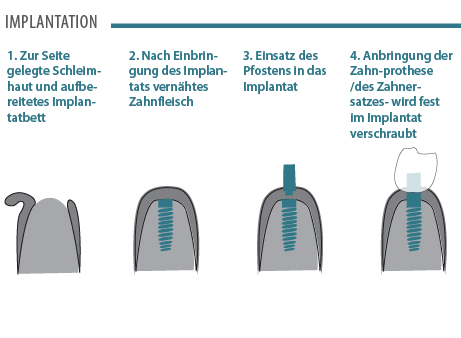
In a standard implant procedure, the gum tissue is gently retracted and an implant is placed into the underlying bone. In an implant procedure involving simultaneous bone augmentation, a small amount of bone is placed over the threads of the implant so that the implant is completely surrounded by bone. In most cases, this bone can be harvested directly from the surrounding area. In the posterior region of the upper jaw, this procedure is called a sinus lift or sinus floor elevation. After the implant is placed, single-button sutures are applied to the small incision to secure the oral mucosa. The sutures are removed within 5 minutes after 7–10 days.
After a dental implant has been placed in the bone, it must fuse with the jawbone before it can bear any load; depending on the initial condition, this process takes between three weeks and three months. Afterward, a dental crown that is indistinguishable from your natural teeth can be placed on top of this artificial tooth root.
If you would like more information about dental implants from our dental practice in Zurich at Bellevue, we’d be happy to assist you. Please contact us!