

Wisdom teeth are among the molars in the human mouth. Unlike the other permanent molars, wisdom teeth usually do not erupt until a person is between the ages of 18 and 22—which is where their name comes from. While the eruption of wisdom teeth does not cause problems for everyone, it can lead to discomfort if the jaw is too small to accommodate these additional teeth.
Characteristics of Wisdom Teeth
Wisdom teeth differ from other molars in various ways—for example, some wisdom teeth have three or five cusps instead of four. The roots of wisdom teeth are also often more pronounced than those of other molars. Furthermore, wisdom tooth roots are frequently curved or intertwined.
Not everyone has the genetic predisposition for wisdom teeth. In some people, however, not only do the usual four (two teeth each in the upper and lower jaws) develop, but up to eight wisdom teeth may form. Since wisdom teeth are located in the eighth position—counting from the incisors—they are also known in dentistry as “8s”; the central incisor is therefore tooth 1.
Possible Complications Caused by Wisdom Teeth
The eruption of wisdom teeth into the oral cavity can lead to various dental problems. If a person has wisdom teeth that are present but do not emerge into the oral cavity, this is referred to as retention. If wisdom teeth only partially emerge through the jawbone or oral mucosa, this is called partial retention.
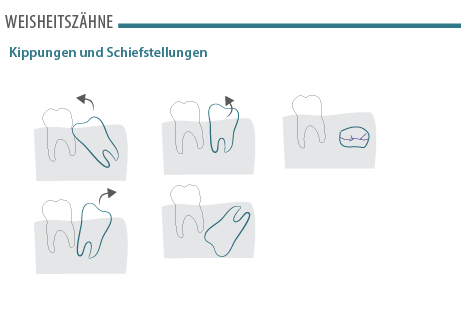
If the wisdom teeth remain completely within the jaw, this often causes no symptoms for the affected patients. Partially impacted wisdom teeth, on the other hand, are often positioned at an angle in the jaw and come into contact with bacteria in the oral cavity. Despite having erupted into the oral cavity, these partially impacted wisdom teeth are very difficult to clean with a toothbrush. Horizontally positioned wisdom teeth can cause the remaining teeth to shift, resulting in misalignment of the teeth in the affected individual. Furthermore, gum pockets form more rapidly around partially impacted wisdom teeth, allowing bacteria to colonize them. Consequences include, among other things, bacterial inflammation of the gums, which in severe cases may occasionally spread to the cheek and/or masticatory muscles. Since wisdom teeth that have not fully erupted into the oral cavity often abut their neighboring teeth without any space between them, the latter are at an increased risk of developing cavities. Furthermore, impacted wisdom teeth can cause resorption of adjacent teeth or dissolve the surrounding tooth structure.
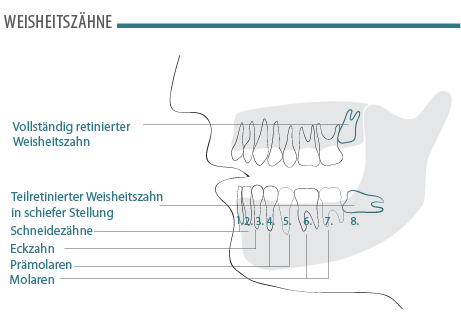
Further complications can also arise when wisdom teeth develop only in the upper or lower jaw—if these teeth lack a corresponding counterpart in the opposite jaw, they may occasionally grow beyond the occlusal plane. As a result, these wisdom teeth often shift position, thereby affecting the teeth in the opposite jawbone. Affected individuals may then experience, for example, teeth grinding and temporomandibular joint pain.
Should You Have Your Wisdom Teeth Removed?
Wisdom teeth that cause complications do not always need to be removed. If a wisdom tooth that has fully erupted into the oral cavity does not interfere with the rest of the teeth but is itself affected by even moderate damage, such as tooth decay, tooth-preserving medical treatment options may be considered, depending on the extent of the damage. At our clinic in Zurich’s Bellevue district, we therefore always make the decision for or against wisdom tooth extraction on a case-by-case basis and in consultation with our patients.
In cases of misalignment, partial retention, and/or retention of wisdom teeth, we recommend their prophylactic removal between the ages of 17 and 25; for example, if a lower wisdom tooth becomes severely inflamed, its surgical removal usually cannot be performed on the same day due to the risk of bacterial spread into the bloodstream (bacteremia). After the age of 25, we recommend removing wisdom teeth only if they are causing symptoms or if there are associated dental conditions.
If you are unsure about the advisability or necessity of having your wisdom teeth removed, we would be happy to advise you based on a dental examination of your teeth.
Wisdom Tooth Extraction—Coverage by Health Insurance
In accordance with the mandatory benefits under Article 17a2 of the Health Care Services Ordinance (KLV), Swiss health insurance plans cover the total cost of treatment at a tax point value of 3.10, minus your annual deductible and copayment. Article 17a2 covers the displacement and excess number of teeth with pathological significance; this applies to only a small number of patients. Our specialists will be happy to determine whether it is worthwhile to apply for coverage by your health insurance and will submit the request to your provider accordingly.
Radiological Evaluation Prior to Surgical Removal of Wisdom Teeth
A simple two-dimensional panoramic X-ray (OPT = Orthopantomogram / OPG = Orthopantomography), which must not be more than two years old, is sufficient in most cases to radiologically assess the position of the wisdom teeth and their adjacent anatomical structures. In about 1–2% of cases, a three-dimensional image must be taken to assess the exact position of the wisdom teeth. Only a few dental practices have this radiological diagnostic capability; at our clinic, you do not need to go to a “radiology institute” as is usually the case—instead, the image can be taken directly on-site at our clinic and takes just 17 seconds (for a minimum field of view (FOV) of 3.5 x 5 cm).
Methods of Wisdom Tooth Extraction
When patients choose to have their wisdom teeth removed at our dental clinic in Zurich, we have various treatment options available. The choice of treatment method depends on the stage of development or the extent of damage to the teeth to be removed.
For example, if we determine that a young person’s jaw will not provide enough space for wisdom teeth that have not yet erupted into the oral cavity, we can perform preventive surgical wisdom tooth extraction. Ideally, such a procedure is performed before the wisdom teeth have fully developed their roots. On average, the appropriate age begins around 15 years old, but is usually between the ages of 17 and 25.
Fully developed wisdom teeth that have erupted from the jaw and need to be removed for various reasons (such as severe damage or impairment of adjacent teeth) can often be extracted using conventional methods.
We, the team at Bellevue Dental in Zurich, would be happy to provide you with expert and personalized advice on any questions you may have regarding your wisdom teeth. Please schedule an appointment.
The Surgical Procedure for Wisdom Tooth Removal
The procedure to remove wisdom teeth—even when surgical extraction is necessary—is a standardized oral surgical procedure and a routine daily procedure for our specialists. Wisdom tooth surgery is performed under sterile conditions, and the dental unit is covered with sterile drapes. Depending on the level of difficulty, the dentist and assistant wear sterile gowns from IVF Hartmann.
We recommend that patients avoid scheduling important appointments (job interviews, important meetings/presentations, etc.) or planning a vacation abroad immediately following wisdom tooth removal. To put it simply, the more you take it easy after the procedure (about 2–3 days), the faster and better you’ll heal. Even after the removal of all four wisdom teeth, over 90% of our patients are able to return to work after 3 days.
During the healing phase following wisdom tooth extraction, we recommend completely abstaining from smoking during the first week, as well as avoiding strenuous physical activity, saunas, and sunbathing, and rinsing your mouth twice daily with a mouthwash solution for one minute each time. A frequently asked question from our patients concerns the use of antibiotics; in most cases, this is unnecessary, as the procedure is performed under sterile conditions by experienced professionals.
For further, detailed information on wisdom tooth treatment, please feel free to contact us. Our team of specialists will be happy to assist you during a personal consultation.