

If you’d like to save a tooth that has been irreversibly damaged or has even died due to inflammation, we can help you achieve that with root canal treatment. In many cases, this tooth-saving procedure allows us to avoid extraction.
When is root canal treatment necessary?
Root canal treatment is often performed on teeth whose pulp is severely inflamed and that are not intended to be extracted. This inflammation is caused by pathogens that enter the interior of damaged teeth. Examples of dental damage that facilitate the entry of pathogens include fractures of the tooth structure, leaky fillings, or extensive tooth decay that has already spread over a large area.
The Root Canal Treatment Process
If you are experiencing severe tooth pain caused by inflammatory processes, we will first assess whether your tooth is a suitable candidate for root canal treatment. To this end, we will conduct a thorough dental examination of your teeth at our Bellevue practice in Zurich.
If we decide together with you to proceed with root canal treatment, we will typically take preparatory X-rays. These images allow us to determine the course and condition of the root canal to be treated, as well as the affected dental pulp. Based on the dental examination and X-rays, we can then provide a customized root canal treatment. In many cases, we perform root canal treatment under local anesthesia. However, if you prefer options such as conscious sedation or general anesthesia, we also offer these alternatives.
Once the anesthesia has taken full effect, we access the interior of the tooth to be treated through the tooth crown.
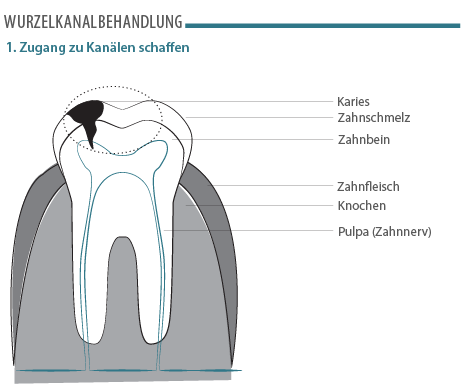
Under microscopic visualization of the treatment site, we use a laser to vaporize not only the damaged dental pulp but also the dental nerve and the affected adjacent tissue. After successful vaporization, the treated root canal undergoes thorough cleaning and smoothing.
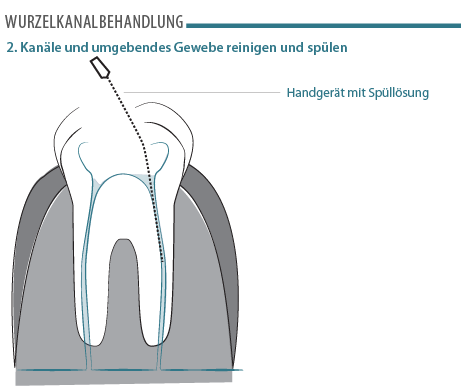
By performing additional disinfection of the cavity created in the tooth, we ensure that no bacteria remain inside the tooth and can lead to renewed inflammation in the root canal. Finally, we seal the interior of the tooth using cement and other filling materials.
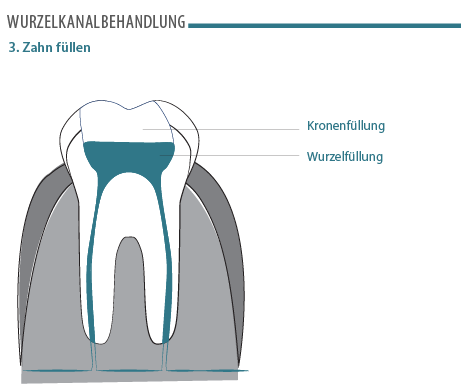
Occasionally, it may be advisable to further stabilize teeth that have undergone root canal treatment using so-called root posts—such a measure should be considered, for example, when a relatively large portion of the tooth structure must be removed due to severe inflammation.
If you would like more information about personalized root canal treatment at our Bellevue practice in Zurich, please feel free to contact us via our contact form.